EXPLAINING SCOTUS FOREIGN INTERESTS
It's the Globalists, Stupid, i.e. the Stupid Globalists

Trump’s Charge against SCOTUS
President Trump’s response to the Supreme Court’s recent tariff decision was not a moment of frustration, but a deliberate accusation aimed at what he described as “foreign interests” influencing the Court. He stated that the Court had been “swayed by foreign interests and a political movement that is far smaller than people would ever think,” a claim that immediately drew attention because of its gravity. Most coverage will focus narrowly on personalities—whether Trump was angry at specific justices—or on China as the presumed culprit. But such interpretations miss the broader context. When Trump’s statement is placed alongside the week’s other major event—the Board of Peace meeting attended by sixty nations—a more strategic picture emerges. Trump is not merely reacting to a ruling, but is identifying a long-standing adversary that has shaped global economic and political systems for centuries.
Defining the “Foreign Interests” and the Economic Ideology Behind Them
The “foreign interests” Trump referenced are not primarily Chinese actors, despite his mention of people with “business in China” who want to “keep ripping us off.” Instead, it’s the organizations that filed amicus briefs opposing Trump’s tariff authority: the U.S. Chamber of Commerce and the Cato Institute. These groups are not Chinese fronts but institutions rooted in Adam Smith–style free‑trade ideology, which have enabled decades of deindustrialization through the influx of cheap Chinese goods. Treasury Secretary Scott Bessant’s remarks reinforce this framing. Speaking after the Court’s decision, he emphasized that economic security is essential to national sovereignty and criticized past administrations for prioritizing “faux efficiency gains and shortsighted profit obsession” over resilience and long-term value. This is not a critique of China but an indictment of the British liberal free‑trade model, which historically extracted wealth from nations and left economic devastation in its wake. The Treasury Secretary’s invocation of Alexander Hamilton’s economic principles—domestic industry, public credit, and essential production—further situates the administration’s policy as a continuation of the early American struggle against British imperial finance.
Tariffs, Economic Sovereignty, and the Human Impact in Georgia
Despite the Supreme Court’s ruling against using AIPA as a tariff mechanism, the administration emphasized that multiple legal avenues remain available. Trump quickly enacted a new 10% global tariff under different statutory authority, and Bessant stated that tariff revenue for 2026 would remain “virtually unchanged.” The document stresses that the real significance lies not in legal technicalities but in the tangible effects of tariff policy on American workers. The day before the ruling, Trump visited a Georgia factory whose owner described how tariffs reversed years of decline. He explained that Chinese competitors had been producing racks for $90 while his cost was $150, making survival impossible until tariffs “leveled” the playing field. After the policy shift, the factory went from layoffs and three-day workweeks to overflowing orders and 36‑week lead times. Trump cited thousands of new manufacturing and construction jobs in Georgia as evidence that the country is shifting from economic decay to renewed vitality. This is the core of the fight: foreign interests want to dismantle this resurgence, and the Court’s decision was one attempt to do so.
The Board of Peace and the Rejection of the Old Global Order
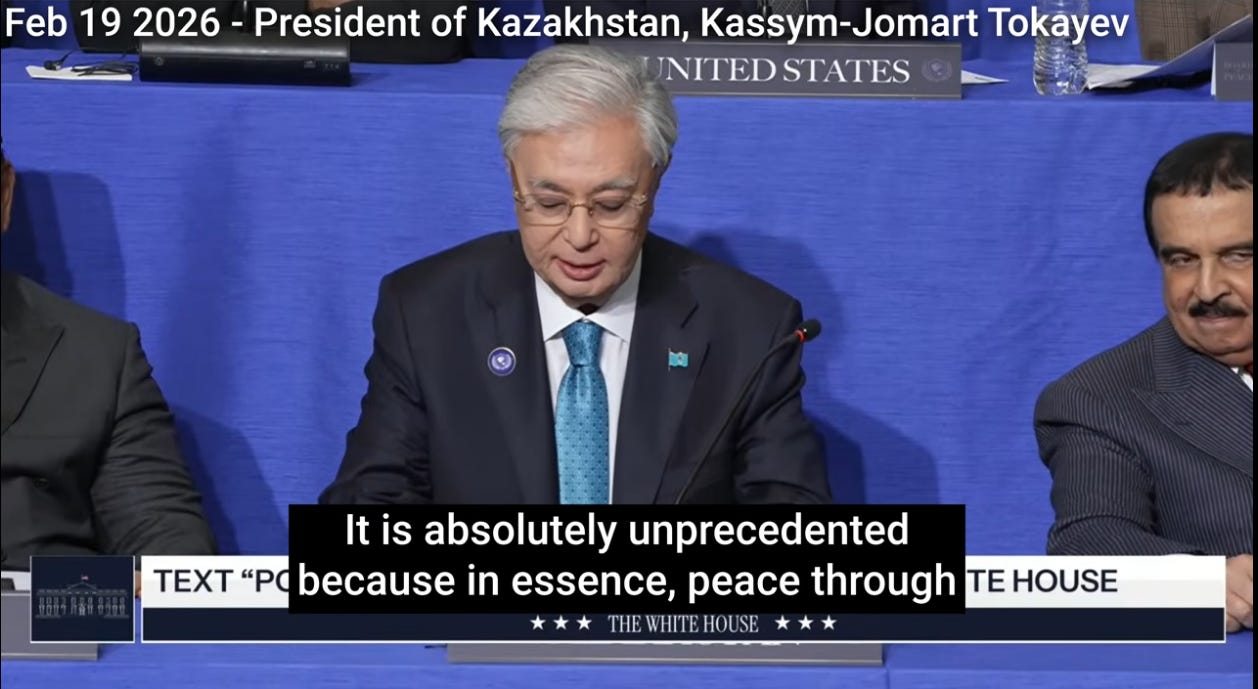
The Board of Peace had a meeting, where sixty nations gathered to support a new framework for resolving conflict through economic development rather than perpetual negotiation. Trump’s introduction of special envoy Steve Witco included a pointed reference to Henry Kissinger: “How would you like to be Henry Kissinger Jr. that doesn’t leak?” This was not a joke but a deliberate repudiation of Kissinger’s legacy. Kissinger was a key architect of a post‑war system that maintained global tensions rather than resolving them, famously stating in a 1982 speech that he kept the British Foreign Office better informed than the U.S. State Department. Trump’s foreign policy is the opposite of this approach. Senator Marco Rubio echoed this by saying that the Gaza situation was “impossible to solve under orthodoxy,” meaning the old system that relied on managed conflict. Leaders at the meeting, including the presidents of Kazakhstan and Paraguay, praised the shift toward “peace through construction”—a model based on economic growth, infrastructure, and practical cooperation rather than endless diplomatic stalemates. Commitments included billions in funding, plans for 100,000 homes in Rafah, and the rapid formation of a Palestinian police force.
A Global System Under Strain and the Stakes for Americans
The narrator argues that the globalist system defended by institutions like the Chamber of Commerce and the Cato Institute is the same system Kissinger helped build—one that relies on war, so-called free trade, and economic extraction. The Board of Peace represents an alternative that many nations have long sought but were never offered. The text emphasizes that the true enemy is not any particular nation, religion, or group of people but a system designed to preserve elite power through conflict and economic manipulation. This system will not allow its influence to be dismantled without resistance. The Cook Political Report is noting that many Americans feel the economic system is “designed for elites at the expense of an American dream that feels increasingly out of reach.” Such anger can be weaponized if people do not understand its origins. According to the document, elites will attempt to demoralize Trump voters—especially younger ones—so they stay home in the midterms, ending the “American system revolution.”
The Choice Ahead
The video concludes by urging Americans to recognize the scale of the struggle. It points to the Georgia factory owner’s revival, the Paraguayan president’s expression of renewed hope, and the Treasury Secretary’s embrace of Hamiltonian economics as evidence of a transformative moment. The narrator frames the week as a clash between an imperial system using the judiciary to halt economic reform and a president rallying sixty nations to build a new order. The final question posed is whether enough Americans will understand the stakes and defend the economic transformation underway.
I’M QUESTIONING THE G IN THE GDP EQUATION
For a few years I’ve thought that the GDP equation was fine as https://mythfighter.com has claimed. But I started questioning that yesterday. -- AI says: From an MMT or American System perspective, the problem with including government spending in GDP arises from how the national accounts treat the components of the standard equation Y=C+I+G+NX, where C represents household consumption, I represents private investment, G represents government purchases of final goods and services, and NX represents net exports. The critique is not that government spending is harmful—both MMT and the Hamiltonian American System view strategic public investment as essential—but that GDP does not distinguish between nation‑building public investment and routine or non‑productive administrative spending, even though both appear in G. As a result, GDP can rise without any increase in the nation’s real productive capacity. Meanwhile, C includes spending financed by transfers (Social Security, Medicare, welfare), which make up nearly half of federal outlays but are not counted in G; I reflects private-sector capital formation, which the American System sought to complement—not replace—with public investment; and NX captures trade balance, which Hamiltonian policy aimed to strengthen through industrial development rather than dependence on imports. Because G only captures about 17% of GDP while total government outlays are closer to 35%, the accounts understate the fiscal footprint of government while overstating its measured “output,” since government services are counted at cost regardless of efficiency. From this viewpoint, the issue is that GDP’s structure fails to differentiate between spending that builds national productive power—Hamilton’s core criterion for economic sovereignty—and spending that merely circulates income without expanding the real economy.